The Rufus Stone, New Forest: History, Walks and Camping Nearby
· Updated
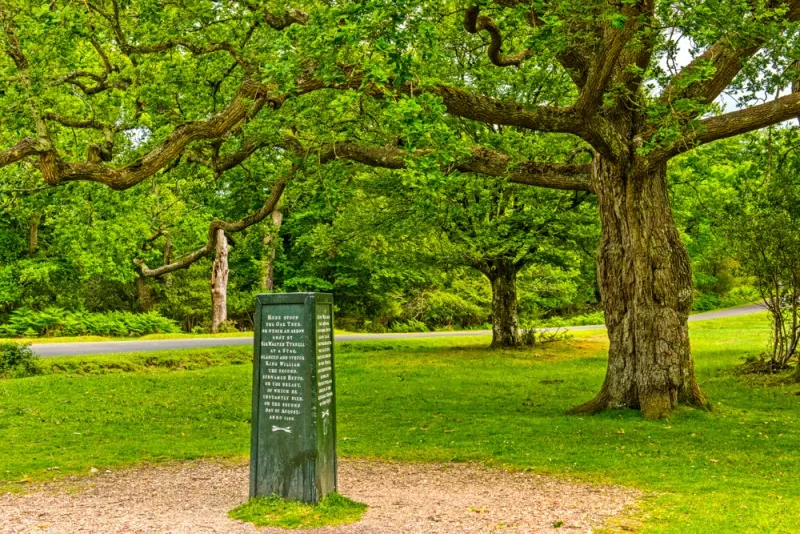
The Rufus Stone is a cast-iron monument near Minstead in the New Forest, and it marks the spot where King William II, known as William Rufus, was killed by an arrow while hunting on 2 August 1100. Whether that arrow was a hunting accident or a deliberate killing is still argued over by historians more than 900 years later, which is a large part of why people still come to find a fairly small pillar in a quiet clearing.
It sits just off the A31 near Cadnam and Brook, it is free to visit, and there is a pub next to the car park named after the man who is said to have loosed the fatal shot. This guide covers the history, how to get there, and where to pitch up nearby. It is part of our wider guide to camping in the UK's national parks, from Camping Sites in Britain, where you can find and compare campsites across the country.
What is the Rufus Stone?
The Rufus Stone is a three-sided cast-iron monument that records the death of William Rufus, third son of William the Conqueror and king of England from 1087 to 1100. The current pillar was put up in 1841 to replace a stone raised in 1745 by Lord John Delaware, which had been chipped away by souvenir hunters until its inscriptions were barely legible. The iron casing was the Victorian answer to that vandalism, and it has done its job.
The monument stands roughly where a large oak tree once grew. According to the traditional account carved onto the stone, an arrow shot by Sir Walter Tyrrell at a stag glanced off that oak and struck the king in the chest, killing him almost at once. It is a specific, physical claim about a specific spot, which is exactly what makes the place worth the short walk.
The inscription
Each of the three faces carries part of the story, copied from the older stone:
- The first face states that the oak stood here, that Tyrrell's arrow glanced off it and struck the king, and that William Rufus died instantly on 2 August 1100.
- The second records that the king's body was laid in a cart belonging to a local charcoal burner named Purkis and drawn to Winchester, where he was buried in the cathedral.
- The third explains that Lord Delaware set up the original marker, and that this more durable memorial with the original inscriptions was erected in 1841.
The death of William Rufus: accident or murder?
Nobody can prove what happened in the clearing, and that is the honest answer. The chroniclers agree that the royal hunting party split up in the late afternoon, that Walter Tyrrell was near the king, and that Rufus was dead by evening with an arrow in his chest. After that, the accounts and the theories diverge.
The accident version is simple: a shot at a deer went wrong in poor light, as shots sometimes did. The murder version points at motive. Rufus was an unpopular and heirless king, and his younger brother Henry was in the same forest that day. Within three days Henry had ridden to Winchester, seized the royal treasury, and had himself crowned as Henry I. Tyrrell, meanwhile, fled straight to the coast and across the Channel to France, never returning to answer for anything and always denying he fired the shot at all.
That is the whole appeal of the place. You are standing where a king died, and 900 years of historians still cannot tell you for certain whether you are standing at the scene of an accident or a coup.
The New Forest: an ancient royal hunting ground
The Rufus Stone only makes sense once you know why a king was out here in the first place. The New Forest was created by William the Conqueror around 1079 as a royal hunting reserve, a "new forest" set aside for the crown and protected by harsh forest law that punished poaching and the clearing of trees. Rufus died hunting on land his own father had enclosed for exactly that purpose.
Nearly a thousand years on, it is still one of the most distinctive landscapes in England, and much of what makes it special comes from rights that predate the monument by centuries.
The ponies and the commoners
The free-roaming ponies you meet on the roads and lawns are not wild. They are owned by commoners, local people whose properties carry ancient rights attached to the land. The most visible is the right of common pasture, which lets them turn animals out to graze across the open forest. Other rights include pannage, the right to release pigs in autumn to eat fallen acorns, and the right to gather firewood.
The whole system is still overseen by the Verderers of the New Forest and managed on the ground by mounted agisters, who look after the roughly 5,000 ponies, cattle and donkeys that graze the area. Give them plenty of room, never feed them, and drive slowly, because animals have absolute right of way and hundreds are killed on forest roads over the years.
Getting to the Rufus Stone
The Rufus Stone is signposted with brown tourist signs off the A31 near Cadnam, close to the hamlets of Brook and Upper Canterton on the north western edge of the forest. Coming off the M27 at junction 1 puts you on the A31 within a couple of minutes, and the turning is well marked from there.
There is a small free car park beside the monument, and the stone itself is only a short, level walk from the cars across the grass, so it is easy to reach with children or anyone who would rather not tackle a long trail. Standing right next to the car park is the Sir Walter Tyrrell, a family pub with a garden that makes an obvious lunch stop, named of course after the man in the story.
The stone also sits in fine walking country. Quiet lanes and forest tracks lead off towards Minstead, Fritham and the open heath, so the monument works well either as a quick history stop off the main road or as the start of a longer wander into the woods. Our guide to the best scenic drives to campsites covers more routes through this part of Hampshire.
Camping near the Rufus Stone
The nearest campsites are run by Camping in the Forest, which operates a cluster of sites on Forestry England land inside the national park. These are simple, back-to-nature pitches on the open forest, often with ponies grazing between the tents, which is about as close as you can get to camping where Rufus once hunted.
| Site | Rough location | Good for |
|---|---|---|
| Ocknell | Fritham, north of the A31 | Closest to the Rufus Stone, open heath pitches |
| Longbeech | Fritham, near Ocknell | Quiet, no hook-ups, deep in the woods |
| Roundhill | Brockenhurst, south of the A35 | Large site, ponies on the pitches, family favourite |
| Ashurst | Ashurst, near the railway station | Easiest arrival by train, handy for Southampton |
Ocknell and Longbeech sit just north of the A31 near Fritham, which makes them the closest bases for a visit to the stone. Roundhill and Ashurst are a little further into the forest but give you more facilities and easy access to Brockenhurst and Lyndhurst. Book ahead in summer, because the forest sites fill fast and pitches are limited by design.
You can browse and compare options across the country in the Camping Sites in Britain directory, and if you would rather pitch under old trees wherever you are, our roundup of the best campsites for exploring ancient woodlands is a good place to start.
Frequently asked questions
Where is the Rufus Stone?
The Rufus Stone stands near Upper Canterton, close to Minstead and Brook on the north western edge of the New Forest in Hampshire. It is signposted off the A31 near Cadnam, a short drive from junction 1 of the M27, and has its own free car park.
Who was William Rufus and how did he die?
William Rufus was King William II of England, the Conqueror's son, who reigned from 1087. He was killed by an arrow while hunting in the New Forest on 2 August 1100. Whether it was an accident or an assassination has never been settled.
Did Walter Tyrrell really kill the king?
The traditional account says Sir Walter Tyrrell fired the arrow that glanced off an oak and struck Rufus. Tyrrell fled to France immediately afterwards and always denied it, so his guilt remains an open question rather than a proven fact.
Is the Rufus Stone free to visit?
Yes. The monument is on open access land with a free car park beside it, and it is a short, level walk from the cars. The Sir Walter Tyrrell pub next to the car park is a handy stop for food and drink.
When was the New Forest created?
William the Conqueror set aside the New Forest as a royal hunting reserve around 1079, protected by forest law. It is why Rufus was hunting there in 1100, and its ancient commoners' rights still shape the landscape today.
What is the closest campsite to the Rufus Stone?
The Camping in the Forest sites at Ocknell and Longbeech, near Fritham just north of the A31, are the nearest. Roundhill and Ashurst are a little further south but offer more facilities. All sit within the national park.
The short version
The Rufus Stone marks where King William II was killed by an arrow in 1100, in a forest his father had enclosed for hunting only 20 years earlier. It is free, easy to reach off the A31, and it comes with a pub, a genuine unsolved mystery, and some of the best simple camping in England on the doorstep.
Make a day of it: find the stone, walk the woods, and pitch up nearby. Browse your options in the Camping Sites in Britain directory or read more about camping in the UK's national parks.