How to Keep Wasps Away When Camping: The UK Guide
The most effective thing you can do about wasps at a campsite is give them something better to eat, ten metres away from your table. Everything else is damage limitation.
Wasps are the reason August bank holiday camping has a reputation. They are not a year-round problem, they are a six-week problem, and once you understand why that is you can plan around them. This guide covers what works at a British campsite, what does not, how to tell a wasp from a bee or a hornet, what to do about a nest, and how to treat a sting.
It is one of the camping guides at Camping Sites in Britain, the place to find and compare campsites, caravan parks and glamping across the UK, and it sits alongside our wider guide to insects and wildlife that bother campers in Britain.
The short answer
Set up a decoy food source away from your table, keep your own food covered, and stay calm when one arrives. In order of how much difference they make:
- Put a saucer of jam or overripe fruit 5 to 10 metres downwind of your table, 15 minutes before you eat
- Cover everything sweet, and never drink from an open can
- Clear plates and wipe the table the moment you finish
- Bag rubbish and walk it to the bins rather than leaving it by the tent
- Check the pitch for a nest entrance before you put the tent up
- Stay still and let one land and leave, rather than flapping at it
- Eat inside the awning or windbreak rather than in the open, if it is really bad
Notice what is not on that list. No spray, no gadget, no plant, no fake nest. More on why below.
Why wasps only bother you in late summer
A wasp colony spends most of the year ignoring you completely. Through spring and early summer the workers are hunting insects to feed the grubs back in the nest, and in return the grubs secrete a sugary liquid that the adult workers live on. The colony is a closed loop and your sandwich is irrelevant.
In late July and August the queen stops laying worker eggs. The grubs pupate, the sugar supply dries up, and several thousand adult wasps are suddenly unemployed, starving and looking for sugar anywhere they can find it. That is the wasp on your beer can. It is not aggression, it is desperation.
This is why the problem appears almost overnight in August, why it is worst in a warm year when colonies grew large, and why it vanishes with the first proper cold snap. It also explains the tactic that works: a starving wasp will take the easiest sugar available, and if the easiest sugar is not on your table, it will not be on your table.
Wasp, bee or hornet?
Get this right before you decide what to do, because the three need completely different handling.
| Feature | Common wasp | Bee | European hornet |
|---|---|---|---|
| Size | 12 to 17mm | 10 to 20mm | Workers 25mm, queens up to 35mm |
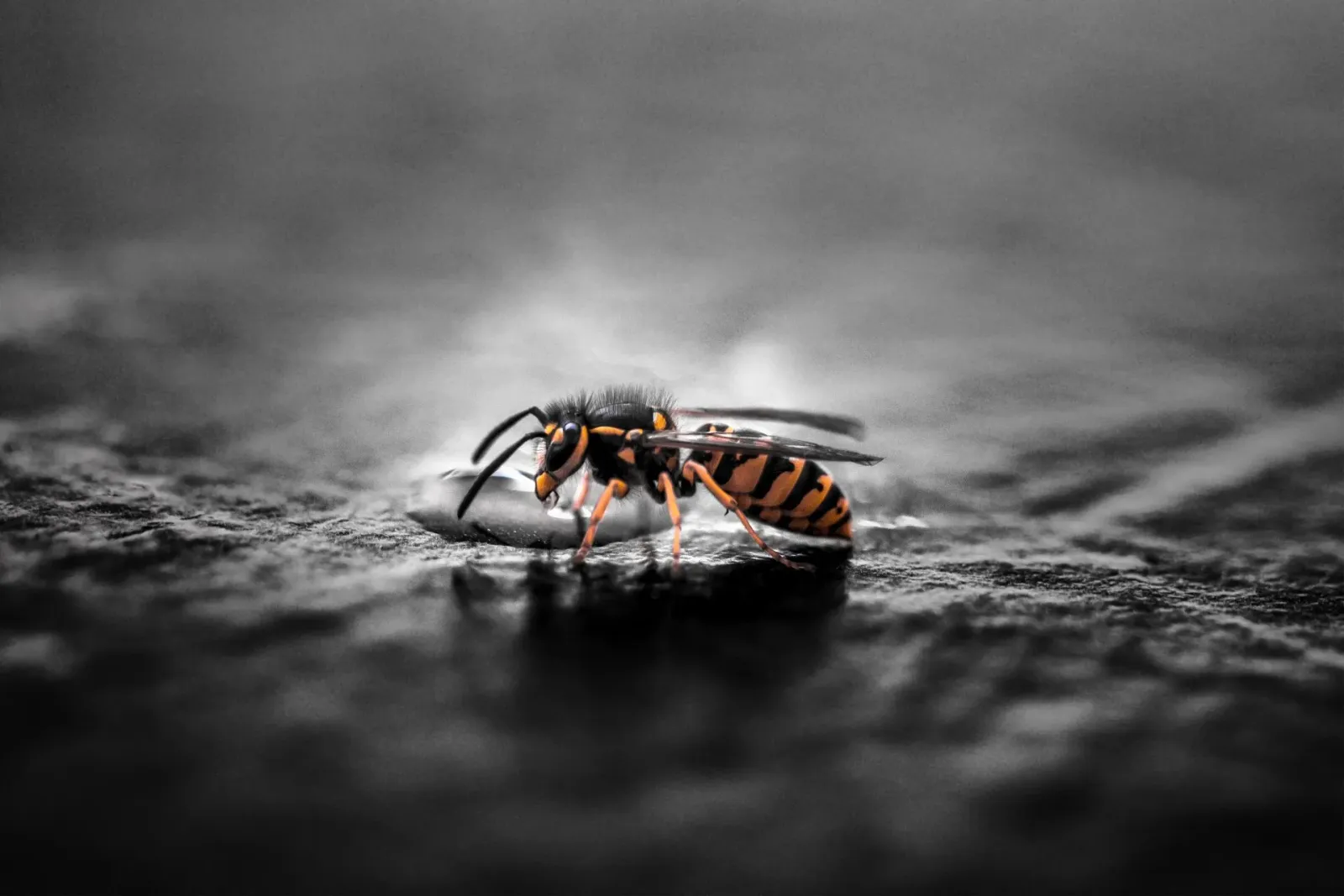
| Body | Smooth, glossy, sharp yellow and black | Furry, dusty, softer edged | Chestnut brown and yellow, noticeably large |
| Waist | Very narrow pinch | Thick, no obvious gap | Narrow pinch |
| Legs in flight | Dangling | Tucked under | Dangling |
| Wants your food | Yes, sugar in late summer, meat in early summer | No | Rarely, prefers hunting insects |
| Temperament | Bold, persistent, will investigate you | Uninterested unless provoked | Docile away from the nest, despite the size |
| Sting | Repeatedly | Honeybee once, bumblebee rarely | Repeatedly, but very reluctant |
European hornets look alarming and are the most misunderstood insect in Britain. Away from their nest they are placid and far less likely to bother you than a common wasp. Leave them be.
If what you have is furry and ignoring your lunch, read our guide to keeping bees away when camping instead. The advice is almost the opposite.
The decoy station: the one trick that genuinely works
Put a sacrificial food source away from where you are eating, and the wasps will go to it instead of you. This is the single most effective wasp tactic available to a camper, and it is barely known outside entomology.
How to do it properly:
- Use something sweet and strong smelling. Diluted jam, overripe plums, the dregs of a fruit juice carton, a squashed banana. In early summer when wasps want protein, a scrap of ham or tinned meat works better
- Place it 5 to 10 metres away. Closer and you are drawing wasps into your pitch. Further and they will not find it before they find you
- Downwind, and away from the path to the toilets. You are creating a small cluster of wasps, so put it somewhere nobody will blunder into it, and tell the people you are camping with where it is
- Set it out 15 to 20 minutes before you eat. The wasps need to find it first. Putting it out at the same time as your dinner is too late
- Top it up. It works for as long as there is food on it
- Clear it away before dark so you are not baiting the pitch overnight or attracting anything else
Match the decoy to what the wasps are actually taking. If one lands on your ham, put ham out. If they are going for the squash, put squash out. Entomologists studying wasp foraging have recommended exactly this approach for outdoor eating, and it is the reason it beats every spray on the market.
One caveat. This is a tactic for a single meal or an afternoon, not a permanent installation. Do not leave a jam saucer out all week.
What works and what does not
| Method | Does it work? | Why |
|---|---|---|
| Decoy feeding station | Yes, best available | Gives a starving wasp an easier option than your plate |
| Covering food and drink | Yes | Removes the reason they came |
| Clearing and wiping immediately | Yes | Wasps recruit. One that finds food comes back with company |
| Checking the pitch for nests | Yes | Most stings happen near a nest, not near a picnic |
| Staying still | Yes | Flapping triggers defensive stinging. Stillness almost never does |
| Eating under an awning or in a windbreak | Yes, partly | Enclosed space with one opening is harder to find than an open table |
| Peppermint, clove and lemongrass oil | Slightly, briefly | Measurable repellent effect in trials, but it fades within an hour or two outdoors |
| Hanging wasp traps | Mixed, often counterproductive | See below |
| Fake paper nests | Weak at best | Common wasps are not strongly territorial towards other nests. Evidence is thin |
| Insect repellent (DEET, picaridin) | No | Formulated for mosquitoes, midges and ticks. Does nothing to wasps |
| Ultrasonic repellers | No | No credible evidence of any effect on insects |
| Planting or hanging herbs | No | Fine in a garden bed over a season. Useless on a two-night pitch |
| Brown paper bags, CDs, copper coins in water | No | Folklore |
| Swatting or spraying an individual wasp | No, dangerous | A crushed or threatened wasp releases alarm pheromone that recruits others |
| Aerosol wasp killer on a nest | No, do not | See the nest section |
Wasp traps: read this before you hang one
A sugar-and-water trap hung at your pitch catches wasps, and also brings more wasps to your pitch. The trap is a lure. You are advertising.
If you use one, hang it 10 metres or more away, at the edge of your area, for the same reason as the decoy station. Never hang one on the tent, the awning pole or the picnic bench.
Two further problems worth knowing. Traps kill indiscriminately, taking hoverflies and other harmless pollinators alongside the wasps. And a trap full of drowned wasps is itself an attractant. If you are only there for a weekend, the decoy station does the job better with none of the downsides.
Choosing and checking your pitch
Most serious wasp stings in Britain happen because somebody disturbed a nest, not because somebody was eating a jam sandwich. Two minutes of looking before you pitch is worth more than anything you do afterwards.
- Watch for a steady two-way stream of wasps going in and out of one point. That is a nest entrance. It can be a hole in a bank, a gap in a dry stone wall, under a shed, in a hedge base or in a tree cavity
- Check the ground. Common wasps often nest underground in old mouse holes. A nest entrance in long grass is easy to miss until you drive a peg through the roof of it
- Look at nearby buildings. Shower blocks, barns and log stores are classic sites. Note where the entrance is and pitch away from the flight line
- Avoid pitching under fruit trees in late summer. Windfall apples and plums ferment on the ground and draw wasps all day
- Avoid the area around the bins. Obvious, and still the most common mistake on a busy site in August
- Keep clear of ivy in flower in September and October, which is a major late-season nectar source
Food, drink and rubbish
- Never drink from an open can. A wasp inside a can that you then swallow causes a sting to the mouth or throat, which is a genuine emergency. Use a glass you can see into, or a bottle with a lid, or a can with a slider cap. This is the single most important rule on this page
- Check the rim and the inside of anything you left standing, including children's cups
- Cover food while cooking, not just while eating. Wasps arrive at the smell
- Clear and wipe within a minute or two of finishing. A wasp that finds food goes back and brings others
- Bag rubbish, seal it, and walk it to the bins. A bin bag by the tent is a beacon
- Rinse recycling before it goes in the crate
- Keep the barbecue clean. Cold fat and meat scraps attract wasps in June and July
- Wipe children's hands and faces after ice creams and lollies
When a wasp arrives at your table
Stay still, keep your hands down, and let it land and leave. A wasp investigating you will move on in a few seconds if you do nothing.
If it settles on your skin, let it. If you cannot bear to, brush it away slowly with a piece of card rather than swatting. Never crush one near people, because the alarm pheromone released will bring others.
Do not blow at a wasp. The carbon dioxide in your breath is a recognised alarm trigger and is a reliable way to turn an indifferent wasp into an angry one.
If a wasp gets inside the tent, open both doors, stand back and let it find the light. If it will not go, cup it against the fabric with a mug and a postcard and carry it out.
If there is a nest on the campsite
Tell the site warden and keep everyone at least a few metres away from the entrance. Do not spray it, do not block it, do not pour anything into it and do not set fire to anything near it.
Aerosol wasp killer sold for domestic use is designed for a nest you can retreat from, indoors, at night. Using one on a nest in a field, in daylight, with your family thirty feet away and nowhere to run, is how people end up with dozens of stings. Nest treatment is a job for the site or a pest controller, not a camper.
A wasp nest is annual. The colony dies out in autumn and the nest is never reused, so nothing needs doing about one you have simply noticed and can avoid. If it is on a pitch or across a path, that is the site's problem to solve, and most wardens will move you to another pitch without argument.
Asian hornets: report them
If you see a hornet with distinctly yellow leg tips and a mostly dark abdomen with one orange or yellow band near the tail, report it. This is the yellow-legged or Asian hornet, an invasive species that threatens honeybee colonies, and Britain runs an active eradication programme that depends on public sightings.
| Asian (yellow-legged) hornet | European hornet | |
|---|---|---|
| Size | 20 to 24mm, barely bigger than a wasp | 25mm workers, up to 35mm queens |
| Legs | Bright yellow tips | Brown throughout |
| Abdomen | Mostly dark, one orange or yellow segment near the tail | Broadly yellow and brown striped |
| Thorax | Dark | Chestnut brown |
| Action | Report it | Leave it alone, it is native and harmless |
Report through the free Asian Hornet Watch app or the online notification form, run by the UK Centre for Ecology and Hydrology for Defra. Include a photograph if you can take one safely and the location. Do not approach a nest.
Wasp stings: what to do
Most wasp stings need washing, a cold compress and nothing else. Wasps do not leave a sting behind, so there is nothing to remove.
- Wash the area with soap and water
- Apply something cold for at least ten minutes, wrapped in a tea towel rather than straight onto skin
- Raise the limb if it swells
- Take an antihistamine for the itch and paracetamol or ibuprofen for the pain
- Do not scratch it, and skip the vinegar and bicarbonate of soda, which do nothing
Swelling that gets worse over the following 24 to 48 hours is normal. A large local reaction can spread across a whole forearm and last a week. It looks alarming and is not dangerous. See a GP or pharmacist if it is still worsening after two or three days, if it becomes hot and increasingly painful, or if you develop a fever, all of which can indicate infection rather than venom.
Call 999 immediately if there is swelling of the face, lips, tongue or throat, wheezing or difficulty breathing, a fast heartbeat, dizziness or fainting. These are signs of anaphylaxis. Help the person use their adrenaline auto-injector if they carry one, and call 999 even if they begin to improve, because symptoms can return. Full guidance is on the NHS insect bites and stings page.
Any sting inside the mouth or throat needs urgent medical help even without allergy, because swelling there can obstruct the airway. This is why the open can rule matters.
Give the ambulance service the campsite name, the postcode and the pitch or field number, and send someone to wait at the entrance. Rural sites are genuinely hard to find.
Dogs and children
Dogs snap at wasps and get stung in the mouth. A sting to the mouth or throat needs a vet call straight away. Elsewhere, a cold compress and monitoring is usually enough, but watch for swelling of the face, vomiting, weakness or collapse, which need an emergency vet. Find the nearest out-of-hours vet before you travel, not while it is happening.
For children, the two rules that prevent most incidents are simple: never drink from an open can, and stand still rather than running and flapping. A child running and screaming at a wasp is far more likely to be stung than one standing still.
When wasps are a problem in Britain, month by month
| Month | What is happening | Risk to campers |
|---|---|---|
| March to April | Queens emerge from hibernation and start nests alone | Almost none. A single large wasp indoors is a queen |
| May to June | Colonies small, workers hunting insects for the grubs | Low. They want protein, not your drink. Watch the barbecue |
| July | Colonies large and still working. Problems start late in the month | Moderate and rising |
| August | Grub sugar supply gone. Thousands of workers seeking sugar | High. This is the peak |
| September | Colonies breaking down, workers dying, behaviour erratic | High, and the wasps are at their boldest |
| October | Numbers collapsing, ivy in flower still draws them | Falling fast |
| November to February | Colonies dead, queens hibernating | None |
If you can choose your dates, June or early July gives you summer weather with a fraction of the wasps. Late August bank holiday is the worst week of the year for it.
Frequently asked questions
What smells do wasps hate?
Peppermint, clove, lemongrass and eucalyptus oils show a measurable repellent effect in trials. Outdoors the effect fades within an hour or two, so treat them as a marginal gain rather than a solution. Removing the sweet smells that attract wasps matters far more.
Do wasp traps work?
They catch wasps, but they also attract them, so a trap near your pitch makes things worse. If you use one, place it at least 10 metres away. A decoy feeding station achieves the same diversion without killing hoverflies and other harmless insects.
Why are wasps so aggressive in August?
The queen stops laying, the grubs stop producing the sugary secretion the adult workers feed on, and thousands of wasps are left starving. What reads as aggression is desperate foraging by insects with nothing left to do.
Should I stay still or run from a wasp?
Stay still. A wasp investigating you will leave within seconds if you do nothing. Flapping, swatting and blowing at it all trigger defensive stinging. Only walk away calmly if you have disturbed a nest, and keep walking in a straight line.
What should I do about a wasp nest at the campsite?
Tell the warden and keep clear of the entrance. Do not spray it, block it or burn anything near it. Nests are annual and die out by late autumn, so an avoidable nest needs nothing done. If it is on your pitch, ask to move.
How long does a wasp sting stay swollen?
Swelling typically peaks 24 to 48 hours after the sting and can last up to a week. A large local reaction spreading across a limb is unpleasant but not dangerous. See a pharmacist or GP if it worsens after three days or becomes hot with a fever.
Can wasps sting more than once?
Yes. Unlike a honeybee, a wasp has a smooth sting and can use it repeatedly. It can also release an alarm pheromone that attracts other wasps, which is why crushing one near people is a bad idea.
Does insect repellent work on wasps?
No. DEET, picaridin and lemon eucalyptus repellents are formulated for mosquitoes, midges and ticks, and have no useful effect on wasps. Choose your camping insect repellent for the biting insects it does work on.
The bottom line
Wasps are a six-week problem with a simple solution. Feed them somewhere else, keep your own food covered, never drink from an open can, and check the pitch for a nest before the pegs go in. Stand still when one arrives and it will leave.
Skip the sprays, the ultrasonic gadgets and the herbs. And if what is bothering you is furry, round and completely uninterested in your lunch, it is a bee, and you want a different guide.
For everything else that bites, stings or raids your food in Britain, see our complete guide to camping pests in Britain.