Cairngorms National Park: A Complete Visitor's Guide
· Updated
The Cairngorms is the largest national park in the UK, covering 4,528 square kilometres of the eastern Scottish Highlands. It was established in 2003 and expanded south into Highland Perthshire in 2010, which is when it took the crown from the Lake District. To put the scale in plain terms, it is roughly the size of Luxembourg and Malta combined, and you could drop the whole of Loch Lomond and the Trossachs inside it twice.
That size is the first thing to understand as a visitor, because you cannot see it in a day and you should not try. This guide is the practical orientation: how to get here, which town to base yourself in, what is worth doing across the seasons, the wildlife to look for and the access rules that apply. It is part of our wider guide to camping in the UK's national parks, and it comes from Camping Sites in Britain, where you can find and compare campsites across the park and the rest of Scotland.
For the trails and the summits we have a separate hiking guide, and for pitches we have a dedicated campsite guide, both linked further down. This page keeps you at the level of the whole park so you can plan the trip before you plan the walk.
Where the Cairngorms is and how big it really is
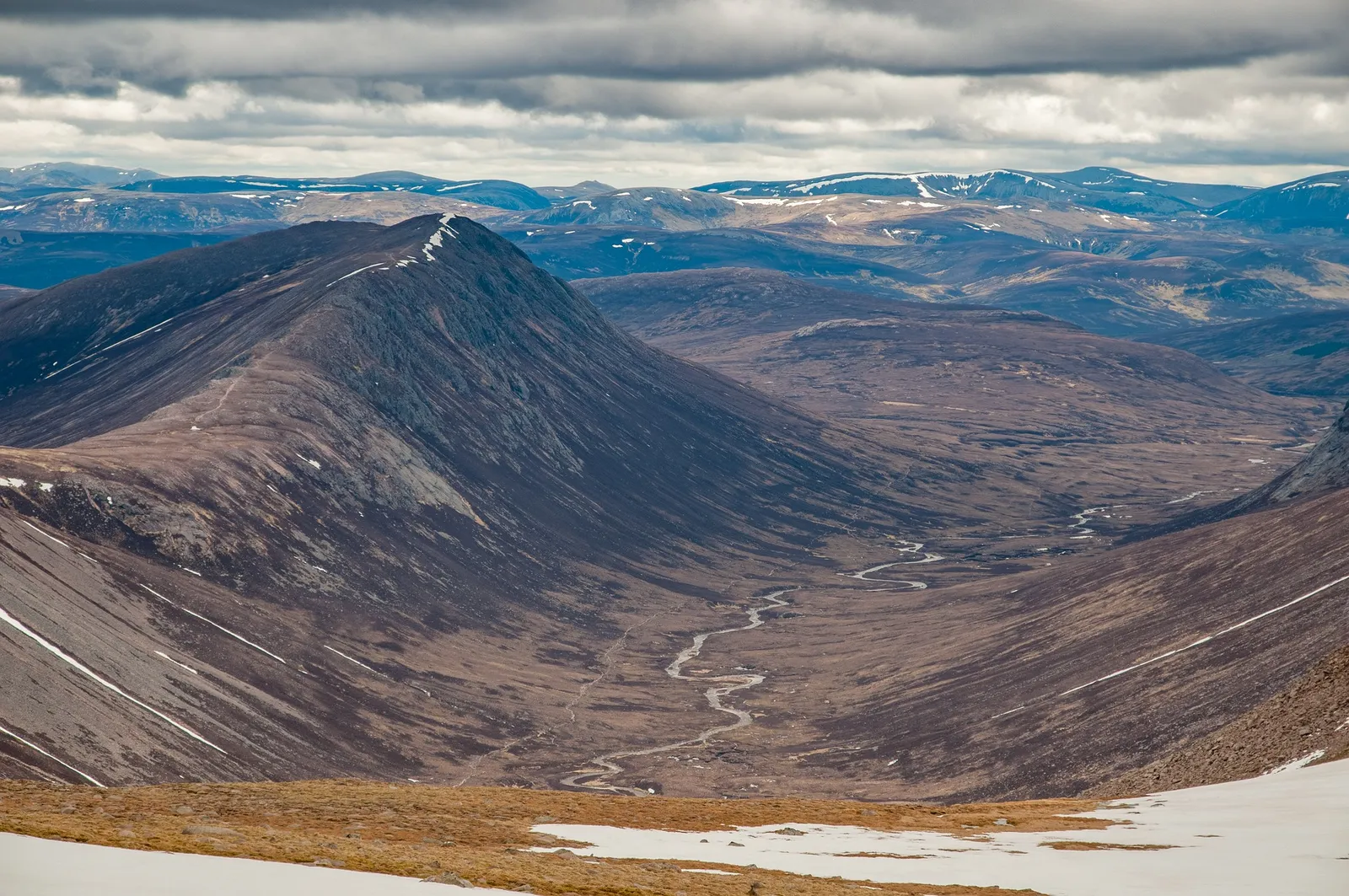
The park sits in the north east of Scotland, spanning parts of five council areas: Highland, Moray, Aberdeenshire, Angus and Perth and Kinross. At its heart is the Cairngorm massif itself, a high granite plateau that holds five of the six highest mountains in the UK. Ben Macdui, at 1,309 metres, is the highest point in the park and the second highest in Britain after Ben Nevis.
The landscape is not all mountain. It takes in the ancient Caledonian pine forests of Rothiemurchus and Abernethy, the River Spey and its whisky-famous strath, moorland, lochs and a scatter of small towns and villages. Understanding that variety matters, because a trip built around Aviemore in the west feels very different from one based on Ballater and Braemar in the east.
Getting to the Cairngorms
The easiest way in without a car is the train to Aviemore, which sits on the Highland Main Line between Perth and Inverness. Direct services run from both Edinburgh and Glasgow and take around three hours, and the Caledonian Sleeper from London Euston stops at Aviemore overnight if you want to wake up in the Highlands.
By road, the A9 is the spine of the journey. It runs the length of the western park and connects Perth to Aviemore and on to Inverness. Aviemore is about a two and a half to three hour drive from both Edinburgh and Glasgow. For the eastern side, Ballater and Braemar are reached on the A93 from Aberdeen or over the high Cairnwell pass from Perthshire, which is the highest main road in the UK and worth the drive in itself.
A car gives you the most freedom here because public transport between the towns is limited, and the A9 makes a natural touring route. If you are travelling by campervan, our guide to the best sites for campervanning in Scotland covers the practicalities of doing the Highlands on wheels.
The main towns and where to base yourself
Where you stay shapes the whole trip, so pick your base by what you want to do. Aviemore is the busy western hub with the widest choice of shops, food and beds; the east is quieter and more genteel around Royal Deeside. Here is how the five main towns compare.
| Town | Best for | Good to know |
|---|---|---|
| Aviemore | First-time visitors, families, outdoor activities | The main hub, on the railway, closest to Cairngorm Mountain and Loch Morlich |
| Grantown-on-Spey | A quieter Speyside base, whisky touring | Handsome Georgian town, 15 minutes north of Aviemore |
| Kingussie | Walkers and a slower pace | Near the Ruthven Barracks and the Insh Marshes, on the railway |
| Ballater | Royal Deeside and Balmoral | Nearest town to Balmoral Castle, in the quieter eastern park |
| Braemar | The high eastern mountains, the Highland Games | Home of the Braemar Gathering each September, gateway to the Linn of Dee |
For first-timers, Aviemore is the obvious call. Almost everything on a starter itinerary is within half an hour of it, and it is the one town you can reach and get around without a car.
Things to do across the seasons
The Cairngorms is a genuine year-round destination, and the best things to do change with the weather. Summer is for water, forests and long light; winter is for snow. Here is what the park does well in each season.
| Season | What to do |
|---|---|
| Spring | Osprey watching begins at Loch Garten, quieter trails, calving red deer, the first warm days on the lochs |
| Summer | Loch Morlich beach and watersports, the Strathspey Railway, forest walks in Rothiemurchus, whisky tours, the funicular for the views |
| Autumn | The deer rut, golden birch and pine, the Braemar Gathering in early September, calmer roads |
| Winter | Skiing and snowboarding at Cairngorm Mountain and Glenshee, the reindeer herd in the snow, short bright walks |
A handful of attractions are worth naming because they anchor most trips:
- Cairngorm Mountain. The funicular railway carries you up towards the plateau for the big views, and the same slopes become one of Scotland's main ski centres in winter.
- The Cairngorm reindeer herd. Britain's only free-ranging herd of reindeer roams the hills near Glenmore, and you can join a guided hill trip to walk among them.
- Loch Morlich. A freshwater loch with a sandy beach ringed by pine and mountain, and a watersports centre hiring kayaks, canoes and paddleboards in summer.
- The Strathspey Railway. A heritage steam line running from Aviemore through Boat of Garten towards Broomhill, a gentle way to see the strath.
- Rothiemurchus. A working Highland estate of ancient Caledonian pinewood, with easy waymarked trails, a farm shop and Loch an Eilein at its centre.
- The Malt Whisky Trail. Speyside is the densest concentration of distilleries in Scotland, and famous names such as Glenlivet and Cardhu sit within easy reach of the park.
- Balmoral Castle. The royal family's Highland home near Ballater opens its grounds and parts of the castle to visitors through the season, and the Deeside setting is lovely in its own right.
The park's ancient pinewoods are one of its rarest features, and if that is your reason for coming, our guide to the best campsites for exploring ancient woodlands is a useful companion. For the drive in and out, the routes over the Cairnwell and along the Spey feature in the best scenic drives to campsites.
Wildlife in the Cairngorms
The Cairngorms holds a quarter of the UK's threatened species, which makes it the best single place in Britain for rare wildlife. Some of it you can see reliably from a hide or a forest path, and knowing where to look changes your odds enormously.
- Ospreys return from Africa each spring and nest at RSPB Loch Garten, where a visitor centre and cameras let you watch the birds on the nest from April to late summer.
- Red squirrels are common in the pinewoods around Aviemore, Rothiemurchus and Abernethy, far easier to spot here than in most of England.
- Capercaillie, the huge woodland grouse, cling on in the Caledonian pine forests, though they are rare and sensitive, so keep to paths in spring to avoid disturbing them.
- Golden eagles soar over the high ground, along with mountain hares that turn white in winter and ptarmigan on the plateau.
Watch quietly, keep dogs under close control near ground-nesting birds and deer, and give every animal room. Ethical wildlife watching is about seeing more by disturbing less.
Access and the Scottish Outdoor Access Code
Scotland gives you a legal right of responsible access to most land and inland water, which is why wild camping and open hillwalking are part of Highland life in a way they are not in most of England. That right comes from the Land Reform (Scotland) Act 2003 and is set out in the Scottish Outdoor Access Code.
Responsible access is the key phrase. It means carrying out all your litter, keeping well away from homes and farm buildings, leaving gates as you find them, controlling dogs around livestock and ground-nesting birds, and taking all fire and toilet waste seriously. Wild campers should stay in small numbers, move on after a night or two and leave no trace of the pitch. The full detail is on the official Scottish Outdoor Access Code site, and it is worth a read before you travel.
Where to stay in the park
The Cairngorms has everything from full-service holiday parks near Aviemore to small hill farms and back-to-basics wild pitches. Because the park is so large, choosing a base near the activities you actually want saves a great deal of driving.
You can browse and compare options across the region in our Scottish Highlands campsite listings, or start wider at the full campsite directory. For help matching a site to the terrain and the weather up here, our guide to how to choose a campsite in the Highlands walks through what to look for.
Frequently asked questions
How big is the Cairngorms National Park?
The Cairngorms covers 4,528 square kilometres, making it the largest national park in the UK, roughly twice the size of the Lake District. It was created in 2003 and expanded south into Highland Perthshire in 2010.
How do you get to the Cairngorms without a car?
Take the train to Aviemore on the Highland Main Line. Direct services from Edinburgh and Glasgow take around three hours, and the Caledonian Sleeper runs overnight from London. Aviemore is the one base you can explore without driving.
What is the Cairngorms famous for?
Its mountains, its ancient Caledonian pine forests and its wildlife. It holds five of the six highest peaks in the UK, Britain's only free-ranging reindeer herd, the ospreys at Loch Garten and Scotland's Speyside whisky country.
When is the best time to visit the Cairngorms?
Late spring and early autumn give the best mix of settled weather, wildlife and quiet trails. Summer is best for the lochs and forests, and winter draws skiers to Cairngorm Mountain and Glenshee.
Is wild camping allowed in the Cairngorms?
Yes. Scotland grants a right of responsible access under the Land Reform (Scotland) Act 2003, so wild camping is legal if you follow the Scottish Outdoor Access Code: small groups, one or two nights, well away from homes, and leaving no trace.
How many days do you need in the Cairngorms?
Three to four days lets you settle in one base, such as Aviemore, and cover the mountain, a loch, a forest and a distillery without rushing. A week lets you take in both the western park and Royal Deeside in the east.
The short version
The Cairngorms is the biggest national park in the UK, and the trick is to base yourself well rather than chase all of it. Aviemore for your first trip, the train if you have no car, and a rough plan built around one loch, one mountain, one forest and one distillery.
When you are ready to book, compare pitches across the region in our Scottish Highlands listings, or read more about camping in the UK's national parks to see how the Cairngorms stacks up against the rest.