The best castles to visit in Dorset
· Updated
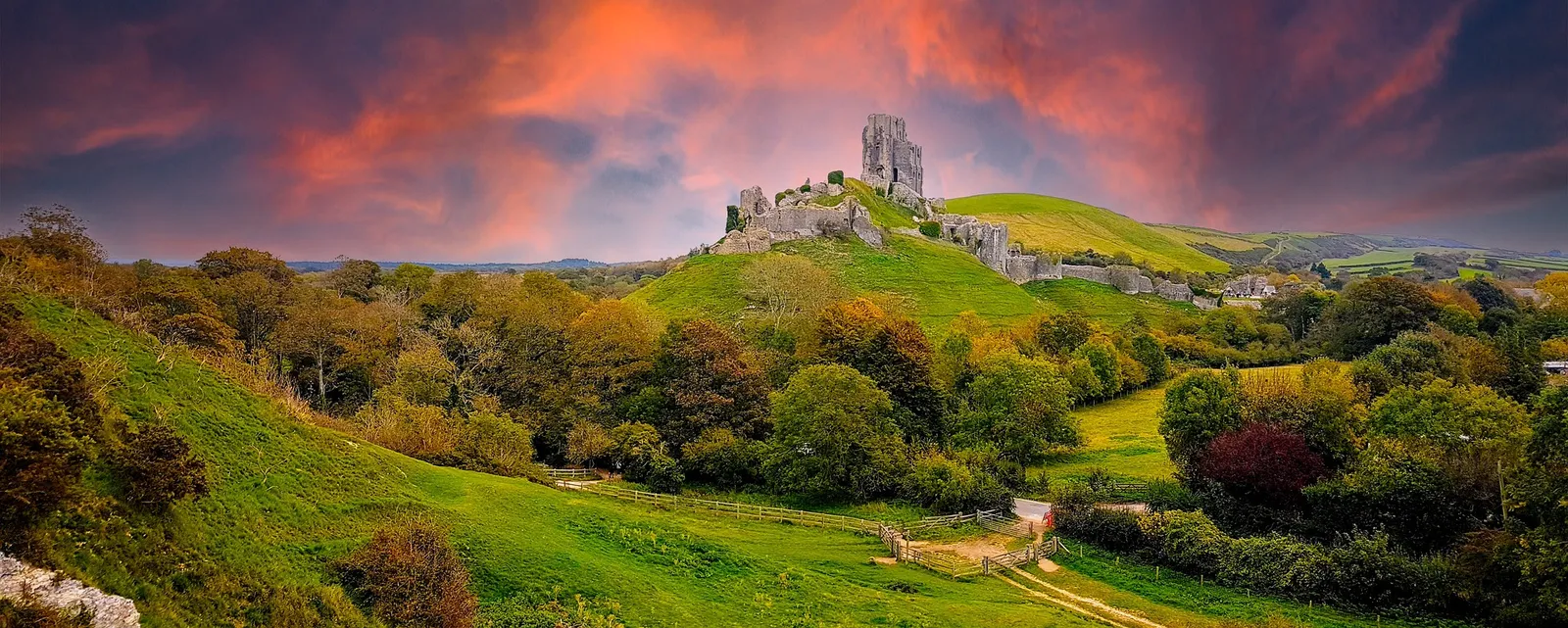
Corfe Castle is the one to see first. It is the county's landmark ruin, a broken silhouette on a hill in the Isle of Purbeck that was deliberately blown up after the Civil War, and no other castle in Dorset matches it for drama. But the county packs in far more than one great fortress: a Tudor artillery fort at Portland, Sir Walter Raleigh's home at Sherborne, a 17th-century hunting lodge near Lulworth Cove, and one of the largest Iron Age hillforts in Europe just outside Dorchester.
This guide names the castles worth your time, what to expect at each, and who looks after them, so you can plan a proper trip rather than a drive-by. Most sit within an easy day of one another, and nearly all are close to the coast.
It is part of our wider guide to camping near Britain's castles, from Camping Sites in Britain, where you can find and compare campsites, caravan parks and glamping across the UK.
Corfe Castle
Corfe Castle is the finest ruin in Dorset and the best place to start. Founded by William the Conqueror in the 11th century and later rebuilt in stone, it commands the only natural gap through the Purbeck Hills, which is exactly why it mattered for 600 years. During the Civil War it was held for the King by Lady Mary Bankes through two sieges, and after it finally fell, Parliament ordered it slighted, or deliberately demolished, in 1646. The dynamited towers and leaning walls you see today are the result.
The castle is owned by the National Trust and sits above the pretty stone village of the same name. The Swanage Railway runs steam and heritage trains from Corfe Castle station, which makes for a brilliant day out with children. Check current opening times and admission on the National Trust's Corfe Castle page.
Sherborne Old Castle and Sherborne Castle
Sherborne has two castles, a short walk apart, and both are worth seeing. Sherborne Old Castle is a 12th-century ruin built around 1120 by Roger of Caen, Bishop of Salisbury. Sir Walter Raleigh took it on in the 1590s, decided it was too old-fashioned to modernise, and built a new house nearby instead. Like Corfe, the old castle was slighted after a Civil War siege in the 1640s. It is now managed by English Heritage, and you can read the details on the English Heritage Sherborne Old Castle page.
Sherborne Castle, the house Raleigh built in 1594, still stands complete a few hundred metres away, extended over the years into a grand Tudor and Jacobean mansion. It sits in a 1,200-acre park with a lake and grounds landscaped by Capability Brown in the 1750s. The house and gardens are privately owned and run by Sherborne Castle Estates, so confirm opening dates on their website before you travel.
Lulworth Castle
Lulworth Castle is a striking early 17th-century building rather than a medieval stronghold. Completed around 1608, it was designed as a hunting lodge in the shape of a castle, all four corners topped with round towers. A fire gutted it in 1929 and left a shell, and it has since been stabilised and partly restored so you can climb the tower for views across the estate.
It sits on the Lulworth Estate near Lulworth Cove and Durdle Door, on the Jurassic Coast, England's only natural UNESCO World Heritage Site. That makes it an easy pairing: castle in the morning, cove and coast path in the afternoon. The estate also hosts events through the summer.
Portland Castle
Portland Castle is one of the best-preserved of Henry VIII's coastal artillery forts. Built between 1539 and 1541 to guard the anchorage of Portland Harbour against French and Spanish attack, its low, curved fan shape was designed to mount heavy guns rather than to look imposing. It saw service right through to the Second World War.
The castle is looked after by English Heritage and overlooks the harbour on the Isle of Portland. You can explore the gun room, the great hall and the Tudor kitchen, and there is a small captain's garden. Check opening times on the English Heritage Portland Castle page. While you are on Portland, look out for Rufus Castle, a small ruined medieval tower also known as Bow and Arrow Castle, perched above Church Ope Cove.
Maiden Castle
Maiden Castle is not a castle in the usual sense but it is unmissable, and it is far older than anything else on this list. Just south west of Dorchester, it is one of the largest Iron Age hillforts in Europe, its huge earthwork ramparts enclosing an area the size of 50 football pitches. People lived and farmed here from around 600 BC, and the Romans stormed it in the 1st century AD.
The site is managed by English Heritage, open access and free to walk at any reasonable time. There are no buildings, just the vast ridged banks and ditches and long views over the Dorset countryside. Details are on the English Heritage Maiden Castle page.
Nothe Fort and Christchurch Castle
Two more contrasting sites round out a Dorset castle trip. Nothe Fort is a Victorian coastal fort at Weymouth, built between 1860 and 1872 to defend the harbour and Portland naval base. It is run by a local charitable trust and now houses museum displays across its ramparts and underground passages, with cannons pointing out to sea. It is one of the more family-friendly sites, with plenty for children.
Christchurch Castle, at the eastern edge of the county, is a Norman motte and bailey ruin dating from the 12th century. The tall fragment of the keep stands on its mound in the middle of the town, alongside the ruined Constable's House by the millstream. It is free to visit and takes little more than half an hour, but it fits neatly with the quay, the priory and the beaches nearby.
Brownsea and the wider Purbeck
Brownsea Island, in Poole Harbour, is best known as the birthplace of the Scout movement, but it also has Brownsea Castle, a much-altered building with Tudor origins as another of Henry VIII's coastal defences. The castle itself is private, but the island is owned by the National Trust and reached by ferry from Poole and Sandbanks, with red squirrels, a lagoon full of birds and easy walking. It makes a good day out from a Purbeck base.
Dorset castles at a glance
| Castle | Type | Looked after by | Where |
|---|---|---|---|
| Corfe Castle | Medieval ruin, slighted 1646 | National Trust | Isle of Purbeck |
| Sherborne Old Castle | 12th-century ruin | English Heritage | Sherborne |
| Sherborne Castle | Tudor and Jacobean house | Sherborne Castle Estates | Sherborne |
| Lulworth Castle | 17th-century hunting lodge | Lulworth Estate | Near Lulworth Cove |
| Portland Castle | Tudor artillery fort, 1539 to 1541 | English Heritage | Isle of Portland |
| Maiden Castle | Iron Age hillfort | English Heritage | Near Dorchester |
| Nothe Fort | Victorian coastal fort | Charitable trust | Weymouth |
| Christchurch Castle | Norman motte and bailey ruin | Open access | Christchurch |
| Brownsea Castle | Tudor coastal fort (private) | National Trust island | Poole Harbour |
Where to camp for a Dorset castle trip
Base yourself in or near the Isle of Purbeck and you are within reach of most of these in a day. Corfe Castle sits at the centre of Purbeck, Lulworth and Portland are a short drive west along the coast, and Weymouth and Dorchester give you Nothe Fort and Maiden Castle. You can browse and compare sites across the county on our Dorset campsites page, from coastal touring parks to quieter farm pitches inland.
If you are touring the wider south west and want more of this, our guide to the top castles in Devon covers the next county along, and our best castles to visit in Somerset guide picks up the ruins and forts to the north. Heading the other way across the country, Kent's castles are the pick of the south east.
Frequently asked questions
What is the most famous castle in Dorset?
Corfe Castle, without question. Its dramatic hilltop ruin in the Isle of Purbeck is the county's best-known landmark, owned by the National Trust and shaped by a Civil War siege that ended with the castle being deliberately demolished in 1646.
Which Dorset castles are National Trust or English Heritage?
Corfe Castle is National Trust. Sherborne Old Castle, Portland Castle and Maiden Castle are English Heritage. Brownsea Island is National Trust, though its castle is private. Sherborne Castle house is privately run, and Nothe Fort is managed by a charitable trust.
Are any castles in Dorset free to visit?
Yes. Maiden Castle and Christchurch Castle are open-access sites you can walk at any reasonable time for free. Most others, including Corfe and Portland, charge admission, so check current prices with the National Trust or English Heritage before you go.
Which Dorset castle is best with children?
Corfe Castle pairs well with the Swanage Railway steam trains, and Nothe Fort at Weymouth has hands-on displays, tunnels and cannons made for exploring. Portland Castle and Brownsea Island, with its red squirrels, also suit families.
Can you see Dorset castles and the Jurassic Coast in one trip?
Easily. Lulworth Castle sits beside Lulworth Cove and Durdle Door on the Jurassic Coast, England's only natural UNESCO World Heritage Site, and Portland Castle, Corfe Castle and Nothe Fort are all close to the same stretch of coast.
The short version
Start with Corfe Castle, add Portland and Sherborne for Tudor history, walk Maiden Castle for something far older, and use Lulworth to tie in the Jurassic Coast. Base yourself in Purbeck and most of it is a day trip away. Browse Dorset campsites or read the full guide to camping near Britain's castles to plan the rest.