The Best Geological Sites in the UK to Visit While Camping
· Updated
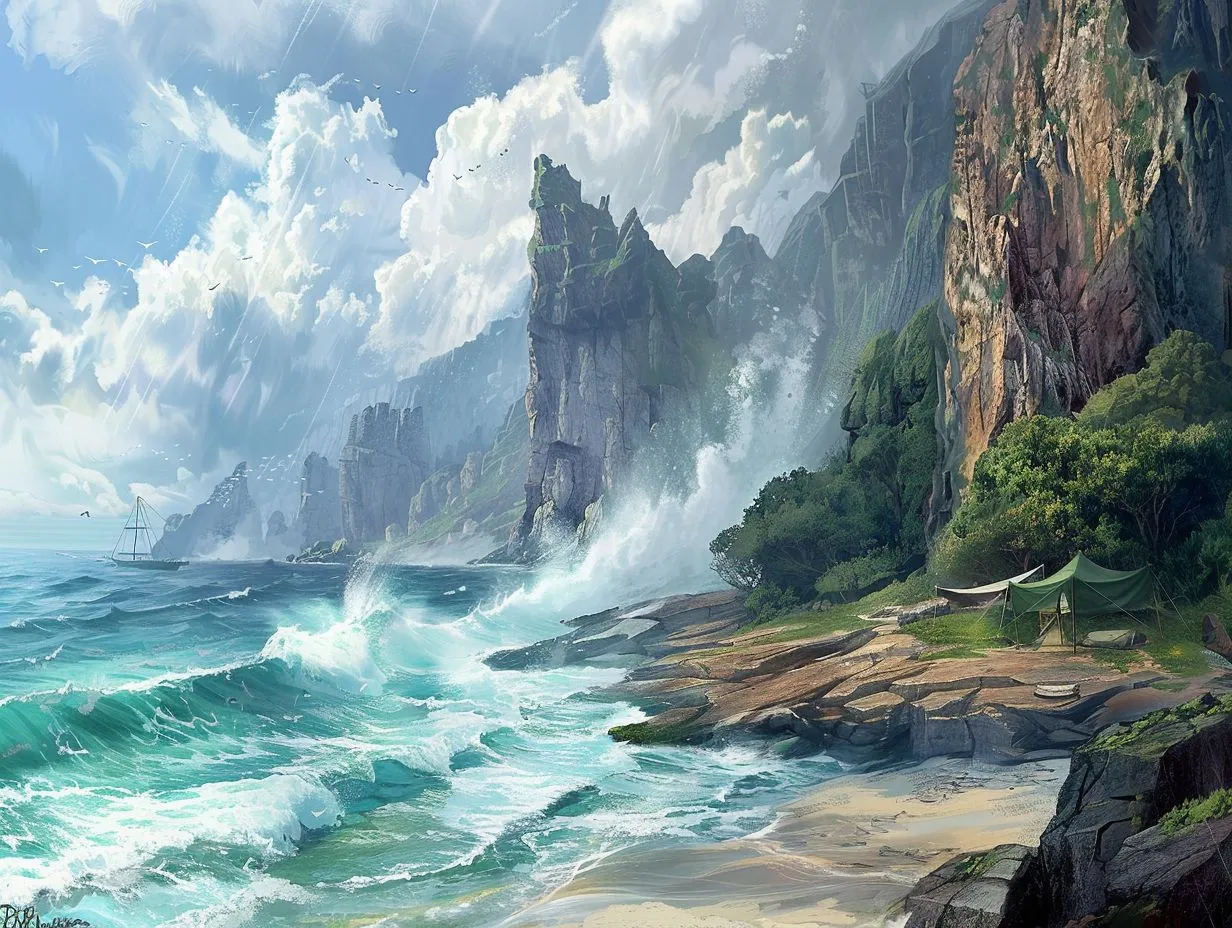
The best geological sites in the UK are the Jurassic Coast in Dorset, the Giant's Causeway in County Antrim, Malham Cove in the Yorkshire Dales, Cheddar Gorge in Somerset, Fingal's Cave on Staffa, the Quiraing and the Old Man of Storr on Skye, Siccar Point in the Scottish Borders and Brimham Rocks in North Yorkshire. Every one of them can be reached on a camping trip, and most sit inside or beside a national park.
These are not just pretty rocks. They record volcanoes, tropical seas, ice sheets and 500 million years of the planet rebuilding itself, and once you know what you are looking at, a cliff or a boulder field turns into a timeline you can walk along. This guide names the sites, explains the geology in plain terms, and points you to where you can pitch nearby.
It is part of our wider guide to camping in the UK's national parks, from Camping Sites in Britain, where you can find and compare campsites, caravan parks and glamping across the country.
The best geological sites in the UK at a glance
Here are the nine sites worth building a trip around, what makes each one geologically special, and the rough age of the rock you are standing on.
| Site | Where | What you are looking at | Age |
|---|---|---|---|
| Jurassic Coast | Devon and Dorset | 95 miles of cliffs recording three geological periods | 185 million years |
| Giant's Causeway | County Antrim | Around 40,000 hexagonal basalt columns | 50 to 60 million years |
| Malham Cove | Yorkshire Dales | A curved limestone cliff and limestone pavement | Around 330 million years |
| Cheddar Gorge | Somerset | England's largest gorge, cut into limestone | Around 340 million years |
| Fingal's Cave | Isle of Staffa | A sea cave lined with basalt columns | Around 60 million years |
| Quiraing and Old Man of Storr | Isle of Skye | Britain's largest active landslip, volcanic rock | Around 60 million years |
| Siccar Point | Scottish Borders | Hutton's Unconformity, the birthplace of deep time | Two rock sets, 65 million years apart |
| Brimham Rocks | North Yorkshire | Balancing gritstone tors sculpted by weather and ice | Around 320 million years |
The Jurassic Coast, Dorset and East Devon
The Jurassic Coast is the single most important geological site in Britain, and the only place in the country where you can walk through 185 million years of Earth's history in a day. It runs for 95 miles from Orcombe Point near Exmouth in East Devon to Old Harry Rocks near Studland in Dorset, and it became England's first natural UNESCO World Heritage Site in 2001.
Walk west to east and you move forward in time, through the Triassic, Jurassic and Cretaceous periods. The rock started as desert, then warm tropical sea, then swamp, and the fossils change as you go. Three landmarks are unmissable. Durdle Door is a natural limestone arch punched through a rib of hard Portland stone. Lulworth Cove is an almost perfect circle where the sea broke through the hard outer rock and scooped out the softer clays behind it. Old Harry Rocks are brilliant white chalk stacks, the same Cretaceous chalk that forms the White Cliffs of Dover, left standing as the coast eroded around them.
This is prime fossil country, and Charmouth and Lyme Regis are the best beaches in Britain for finding ammonites and belemnites straight out of the crumbling cliffs. For the full fossil-hunting run, see our guide to the best campsites for dinosaur fossil hunting. Dorset has campsites all along this coast, and you can browse and compare them on our Dorset campsite listings.
The Giant's Causeway, County Antrim
The Giant's Causeway is the finest example of columnar basalt in the world, roughly 40,000 mostly hexagonal columns stepping down into the sea. It became a UNESCO World Heritage Site in 1986 and remains Northern Ireland's most famous natural landmark.
The geology is volcanic and surprisingly simple. Between 50 and 60 million years ago, molten lava flowed out across the landscape and cooled slowly. As it contracted it cracked, and thick, evenly cooled lava tends to crack into neat polygons, the same way drying mud does. The result is thousands of tightly packed columns, some more than 12 metres tall. Legend credits the giant Finn McCool, which is more fun, but the honest answer is cooling lava.
The site is managed by the National Trust and the cliff-top and shore paths can be steep and slippery, so proper footwear matters. Camping is not allowed at the Causeway itself, but there are sites along the Causeway Coast and around Bushmills within easy reach.
Malham Cove and Cheddar Gorge: limestone country
Malham Cove and Cheddar Gorge are the two best places in England to understand what water does to limestone over hundreds of thousands of years. Both were carved from Carboniferous limestone laid down around 330 to 340 million years ago, when Britain sat near the equator under a shallow tropical sea.
Malham Cove, in the Yorkshire Dales, is a curved limestone cliff about 80 metres high, once the site of a waterfall bigger than Niagara fed by Ice Age meltwater. On top sits one of the finest limestone pavements in Britain, a grid of flat blocks (clints) split by deep runnels (grikes) where slightly acidic rainwater has dissolved the rock along its cracks. Cheddar Gorge in Somerset is England's largest gorge, with cliffs rising close to 140 metres, cut by meltwater rivers at the end of the last Ice Age and riddled with caves below.
The Dales are walking country and reward an early start, so it is worth reading up on the best scenic drives to campsites before you go. To pitch near Malham, browse our North Yorkshire campsite listings.
Fingal's Cave, the Quiraing and the Old Man of Storr: volcanic Scotland
Western Scotland is where Britain's volcanic past is easiest to see, and three sites stand out. All three were shaped by the same wave of volcanic activity around 60 million years ago, when the Atlantic was tearing open and lava poured across what is now the Inner Hebrides.
Fingal's Cave, on the tiny uninhabited island of Staffa, is a sea cave lined with the same hexagonal basalt columns as the Giant's Causeway, formed from the same lava province. Its natural acoustics inspired Mendelssohn's Hebrides Overture. On the Isle of Skye, the Old Man of Storr is a jagged pinnacle of rock left standing after a huge ancient landslip, and the Quiraing nearby is part of the largest landslide in Britain that is still slowly moving today. Both formed where heavy volcanic basalt slid over softer sedimentary rocks beneath.
Skye and the west coast take planning, especially the ferries and single-track roads, so read our guides to choosing a campsite in the Highlands and campervanning in Scotland. You can also browse campsites across the region on our Highlands campsite listings.
Siccar Point: where modern geology was born
Siccar Point, on the Berwickshire coast in the Scottish Borders, is the most important geological site in the world for the history of the science itself. It is where James Hutton, in 1788, found the proof that the Earth is unimaginably old.
What Hutton saw is called an unconformity. Below sit beds of grey rock (greywacke) that were laid down flat, then folded until they stood almost vertical, then worn down. On top of them lie beds of Old Red Sandstone, laid down flat much later. The gap in time between the two sets of rock is around 65 million years, a gap so vast that Hutton wrote he could see "no vestige of a beginning, no prospect of an end". That single outcrop overturned the idea that the world was a few thousand years old and gave us the concept of deep time. It is a low-key spot with no visitor centre, reached by a short walk down a steep field, and it is more moving than it has any right to be.
Brimham Rocks, North Yorkshire
Brimham Rocks is the best place in England to see how wind, water and ice can sculpt solid rock into something that looks impossible. This scatter of balancing boulders and towers sits on a moor above Nidderdale and is looked after by the National Trust.
The rock is Millstone Grit, a coarse sandstone laid down around 320 million years ago by a huge river delta. Over millions of years, wind-blown sand, frost and rain wore away the softer layers faster than the harder ones, leaving top-heavy tors with names like the Idol and the Dancing Bear. It is free to visit, brilliant for children who want to scramble, and an easy add-on to a Yorkshire Dales trip.
How to visit geological sites responsibly
The golden rule at every site is to leave the rock as you found it. These places survive because visitors take photographs rather than souvenirs, and many sit within protected landscapes and national parks where the same principle underpins the whole visit.
- Follow the fossil code where it applies. On the Jurassic Coast you may collect loose fossils from the beach and shingle, but you must never hammer or dig into the cliffs, which is dangerous and damages the site.
- Stay back from cliff edges and cliff bases alike. The Jurassic Coast cliffs are actively eroding and rockfalls are common, especially after rain.
- Stick to marked paths on limestone pavements and landslip terrain, where the ground is uneven and holes between blocks can turn an ankle.
- Check tide times before walking below any sea cliff, and never get cut off by a rising tide.
- Follow the Countryside Code in England and Wales and the Scottish Outdoor Access Code in Scotland, and take all litter home.
Full guidance on collecting responsibly is on the Jurassic Coast Trust fossil finding page.
Frequently asked questions
What is the most famous geological site in the UK?
The Jurassic Coast in Devon and Dorset and the Giant's Causeway in County Antrim are the two most famous, and both are UNESCO World Heritage Sites. The Jurassic Coast records 185 million years of history across 95 miles, while the Giant's Causeway is the world's finest display of basalt columns.
Where is the best place to find fossils in the UK?
The beaches at Charmouth and Lyme Regis on the Jurassic Coast in Dorset are the best in Britain for fossils. Ammonites and belemnites wash out of the eroding cliffs, especially after winter storms. Collect only loose fossils from the beach and never hammer the cliffs.
Can you camp near the Giant's Causeway?
Yes. Camping is not allowed at the Causeway itself, but there are campsites and caravan parks along the Causeway Coast and around Bushmills, all within a short drive. Book ahead in summer, as the area is busy.
Why does the Giant's Causeway have hexagonal columns?
The columns formed as a thick sheet of lava cooled slowly and contracted around 50 to 60 million years ago. Even cooling makes rock crack into regular polygons, most often hexagons, in the same way drying mud cracks into neat shapes.
What is Hutton's Unconformity at Siccar Point?
It is a point where two sets of rock, formed about 65 million years apart, meet at an angle. James Hutton used it in 1788 to prove the Earth was vastly older than anyone believed, which gave us the idea of deep time and effectively founded modern geology.
Are UK geological sites suitable for children?
Many are excellent for families. Brimham Rocks is made for scrambling, fossil hunting at Charmouth keeps children busy for hours, and Malham Cove is a manageable walk. Others, such as the Old Man of Storr and cliff-edge paths, need care and sensible footwear.
The short version
Britain packs an astonishing range of geology into a small island, from tropical-sea limestone in Yorkshire to cooling lava in Antrim and the very outcrop that proved how old the world is. Pick a site, learn the one thing that makes it special, and the landscape opens up. When you are ready to build a trip around one, start with camping in the UK's national parks or browse the full campsite listings to find your pitch.